

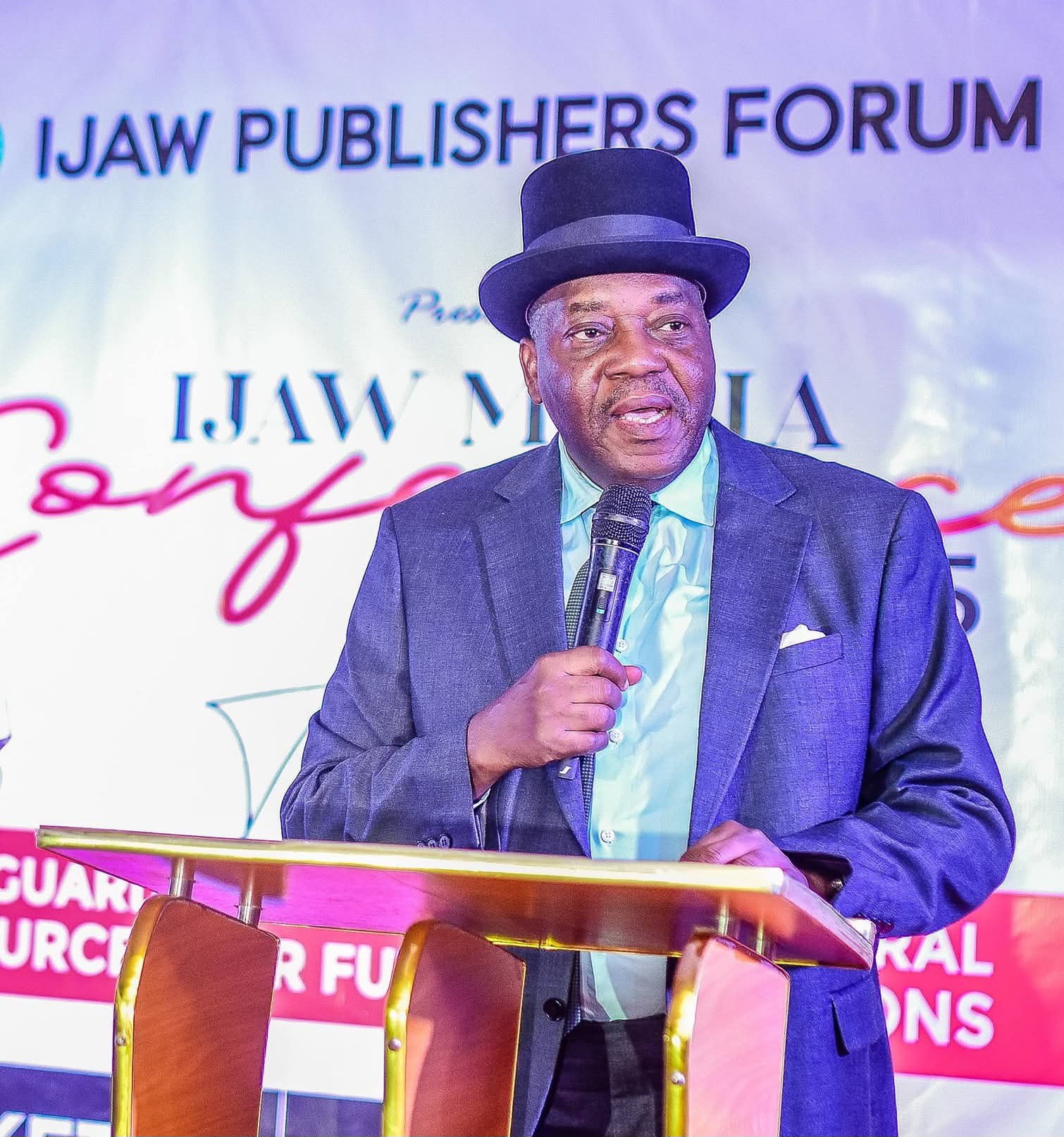
BEING KEYNOTE ADDRESS BY AMB. GODKNOWS IGALI, NATIONAL CHAIRMAN, PAN NIGER DELTA FORUM (PANDEF)
AT THE 2ND MEDIA CONFERENCE OF IJAW PUBLISHERS FORUM, HOLDING IN WARRI, DELTA STATE
17TH DECEMBER, 2025
PROTOCOL
I will like to thank the leadership of Ijaw Publishers Forum (IPF) for inviting me to be part of this celebration of the Second Annual Conference holding today in our great ancient city of Warri. I must congratulate you for the consistency of purpose which has defined your focus in organising this annual gathering to discuss topics of common interest. For the fact that you have again brought such an army of leading minds of the Ijaw nation, Niger Delta and Nigeria for us to brainstorm, I commend you for sustaining the momentum. I must therefore not fail to express the confidence that our gathering every year in this manner has come to stay and will grow from strength to strength.
On this occasion, also permit me to appreciate the leadership of the IPF for all that you have achieved in bringing our media practitioners into one roof. I am sure by now you would have realised the power of unity and the common benefits that come with it. At an age and time in which knowledge has become power, and indeed rules the world, the fact that you are united in this manner, gives you more strength, and also a stronger greater voice in the national landscape of mass media and public communication.
But you must be firmly united. According to the 19th century American business magnate, Henry Ford, “Coming together is a beginning, staying together is progress, and working together is success.” . This confirms the old African saying that “of you want to go fast, go alone. But to far, go together. IPF must patiently together and go very far into the future.
ON WHY WE ARE HERE
Today, you have assembled us as a people to talk on the topic: Safeguarding the Natural Resources of the Niger Delta. Undoubtedly, this is quite apt to the times in which we live and the future which we want to carve out for ourselves and our children yet unborn. It is of great excitement that you are so focused and foresighted not to think of today but to look beyond our times, into the future and talk about our tomorrow.
Indeed, let me say this. The importance of tomorrow is that it holds great significance and encapsulates our hopes, our visions and it is an urge to a new beginning. This is because every new day is a fresh start and every tomorrow is pregnant with immense possibilities and opportunities. Beyond that, the future presents us all with an opportunity to make right the wrongs of today and of yesterday. In fact, let me add that the future is an opportunity for us to plan anew and in doing so, also set goals and prepare ourselves for a future that is assured. Ultimately a future and our tomorrow that will enable us perhaps in our very old age and times of our children and those unborn to have abundant joy and effectively navigate through the challenges that would happen ahead of them. Yes, perhaps even have the great competitive edge over all others.
So, this also means setting standards for them to be more responsible, more united, and in their own time, have the capacity to dominate all what they meet in life.
ON NIGER DELTA PEOPLE AND RESOURCES
As we all know, the Niger Delta or the South-South, so to say, is perhaps the most endowed part of Nigeria. In terms of human populations, it represents in a distinct manner, the defining crucible of the diversity and strength which makes Nigeria peculiar in the comity of nations. So from the point of view of demography, we account for over 50 million people out of Nigeria’s population of about 220 million. Interesting enough, this is made up of at least 40 distinct ethnic groups, even though often the Ijaws, the Urhobos, the Ibibio are listed as more populous.
As for the Ijaws, we are the dominant and largest ethnic group and are found in virtually all the states of the area. As a matter of fact, we the Ijaws going to about a population of 20 million and is the 4th largest ethnic group in Nigeria and occupying the major part of the coastline of Nigeria which today stands at 853 square kilometres on the Gulf of Guinea. But more significantly, we are in virtually every state of the Niger Delta in sufficient numbers, contributing actively to the growth and development of the country.
The Niger Delta’s main feature is its very fragile terrain and ecology. The area is actually the huge delta, created by River Niger which stands at about 70,000 – 120,000 sq. km. This huge delta which is the largest in Africa comprises mostly wetlands, i.e. mangrove swamps, fresh water forest and dense equatorial rain forest. As a matter of fact, some studies show that the Niger Delta may in actual sense be the world’s second largest delta, stretching from north to south 240 km and 320 km along the coast.
NIGER DELTA NATURAL RESOURCES
The Niger Delta holds huge part of Nigeria’s natural resources. Many times, we tend to look only at oil and gas which I shall detail shortly. However, some of these include such unmentioned ones as;
i. Lowland Rainforest: which are dense tropical forest with high biodiversity and home to some of the rarest mammals, plants in all of Nigeria. a good part of the continent’s rain forest is still held by the Niger Delta;
ii. Freshwater forests: these inland forests hold some of the most fragile vegetation that support unique aquatic systems, some of which are peculiar to Nigeria. For example, there is a greenback turtle which comes from all over the world, travelling thousands of kilometres by water, only to spawn around Akassa in Bayelsa State, to go back once a year. This still remains a mystery to the whole world of animal scientists.
iii. Fresh water swamps: the area also holds some of the country’s medicinal plants, timber, gum, rubber. Hence a good part of Nigeria’s remaining endangered animals, such as crocodiles, monkeys, antelopes, unique birds like the grey parrot, fish, pygmy people are found mostly in the Niger Delta.
iv. Sandy coastal ridges: A very good portion of the country’s sand, clay, silica, marble, uranium deposits are still held in the Niger Delta.
v. Solid minerals: the area also has huge deposits of significant amount of other minerals, especially bitumen, lignite, limestone, clay, kaolin, gypsum, iron ore, lead/zinc ores, coal. These are found all over the area and are very important for the construction industry, energy, for cement production as well as used in ceramics, tiles and industrial use. Another major source of minerals which is not mentioned is salt and decorative minerals such as gold and silver.
In what appears like a blessing in disguise, all these sources of minerals have been largely left undeveloped. This is an area that lies ahead of us and we must make conscious efforts to begin to work on it in terms of undertaking detailed studies on it.
THE STORY OF NIGER DELTA OIL AND GAS
Perhaps the most significant natural resource for which the Niger Delta is known all over the world is oil and gas deposit which is produced in abundance. From the time when oil was discovered in Oloibiri in Bayelsa State in 1956 and up to 1958 when the first barrels of oil were exported, the Niger Delta has taken Nigeria to become a major player in the global oil and gas industry. Accordingly, between 1961-2014, Nigeria has exported 32.7 billion barrels of crude oil. According to NBS, by 2004, Nigeria attained a peak production of 2.5 million bpd. At present, we are doing between 1.5 and 1.7 million bpd. However, OPEC data shows that in November 2025, Nigeria production has fallen down to 1.486 million bpd. So, whatever the situation, OPEC believes that Nigeria’s production will continue to be at over 1.4 million bpd and aware that efforts are top gear by the NNPC to increase output.
At global level, this has made Nigeria 16th in the world and no. 1 in Africa. The country’s reserve still stands at 37.28 billion as at January 7, 2025. This means the amount of crude oil that we have, can critically play a major role in our national economy for the next 70 years. Beyond this, Nigeria’s Upstream Regulatory Commission (NUPRC) continues to make strenuous efforts to see that it increases oil production to 3 million barrels per day, maybe going up to, by 2030. If attained, this will place Nigeria at about number 10 in the global market.
What is interesting about Nigeria’s oil production is the fact that we have the light, sweet, low sulphur crude. This makes it premium and highly valuable for refining. It is also highly sought after all over the world.
In terms of monetary value, Nigeria’s crude sales over the years has brought tremendous wealth to the country and has been the bedrock of national development. While this goes into billions of dollars since the 1970s, some more recent figures show tens of trillion of naira being earned annually. For example, in 2024, exports from oil is believed to have earned the country ₦50.8 trillion which is about $33 billion. Some other reports also show that between 1999 and today, Nigeria has earned about $831 billion and perhaps accounted for over 70% of government revenue.
It is also important for us to aver our minds to the fact that our oil and gas sector has not only been a story of crude oil alone but also of natural gas. Sadly, for many decades, this associated gas was ignored and burnt away, polluting our environment in a terrible way. We therefore earned very little from it. Today, this stands at about 7.59 billion standard cubic feet daily average by the last account in 2025, which takes us to about 1.3 trillion standard cubic feet annually.
This notwithstanding, Nigeria has a proven reserve of over 210 trillion cubic feet of gas.
With the completion of the Liquefied Natural Gas project in Bonny, Nigeria has also started earning billions of dollars from the sale of gas. This has been going up to ₦8.6 trillion naira, (about $8 – $10 billion) on annual basis.
According to one source, NLG has raked in as much as $25 billion since its first 15 years of operation and this number continues to increase. Now that this gas is no longer being flared again, in the first quarter of 2025 alone, available statistics shows that $2.7 billion came in and this number is expected to be the benchmark for all of the year.
Also, more fundamentally, the government has started to focus on domestic gas usage and pursuit of policies to base the country’s energy mix on gas, particularly for gas industries, projects, cooking gas and gas for public transportation. Let us also look at the employment imperative. Available statistics show that for every $1 billion in upstream oil and gas investment, it creates 4-6 thousand direct and indirect jobs.
Natural gas is considered one of the cleanest, cheapest and safest energy sources of the world. This real-time fact will continue into the future. So the current annual inflow of investment placed at $20billion is projected to increase to $60 billion in the foreseeable future. This is huge and will place us at the vortex of global energy sector.
PROTECTING OUR NATURAL RESOURCES FOR OUR TOMORROW
The above scenario is quite rosy and gives us the assurance that the Niger Delta will continue to be very relevant in Nigeria and the world of tomorrow. However, there are certain critical factors that we must take into consideration. These include the fact that:
i. Seeing the Hope of a Bright Future: We must see that God has blessed us and kept us in the best terrain that any Nigerian can wish to be. We have the best terrain and we must therefore see the availability of our natural resources in a holistic manner. There is still so much for us to thank God for, appreciate and develop and not only focus on oil and gas.
In this respect, we must look at all areas, starting with
EDUCATION;
Accorsing to Nelson Mandela, “Education is the most powerful weapon which you can use to change the world.” Our populations which are very dynamic must have easy access to best of education in Nigeria and Africa. Our present investment in education is still too low and we are not doing enough in this regard. The future of the world will be decided by knowledge. Hence countries with relatively low populations and least of natural resources but strong in education, technology, innovation are dominating the world. Korea, Japan, Israel, Europe, etc.
Our governments must prioritise education and give the highest priority to it. In 2025, we budgeted a total of ₦546 billion in the 6 states into education. This might appear big but when we compare the total annual budget of our 6 states in the same year which was as high as ₦6.38 trillion, we will realise that what was allocated to education was paltry. If we have an educated population, we can dominate the labour market in Nigeria and perhaps all of Africa. In particular, some states such as Delta and Bayelsa have some of the lowest education budgets nationally around 18.9% while other states such as Kano, Jigawa and Kaduna met the UNESCO’s benchmark of 26%. This must be addressed squarely and urgently.
THE RIGHT ENABLING ENVIRONMENT
Agreed that we have huge natural and human resource potentials, however we must ensure that there is peace in our region to enable investors come with their resources to join us. The reign of such high spread of organised crimes as armed robbery, kidnapping, piracy, oil theft, clashes between criminal groups, clashes between communities will only create a perception of insecurity. For us Ijaws, even the practice of communities and the IYC going to disrupt legitimate economic growth activities must be curtailed or stopped completely.
According to recent studies by PIND, “risk factors continue to show that Niger Delta remains a critical area of watch”. continue to be areas of one would have thought that with the end of the period of Niger Delta crisis by late 2000s, specifically with the Amnesty Programme, the various pockets of criminalities will come to almost zero in our area.
ADDRESSING EXTERNAL DRIVERS OF INSTABILITY
We must address the drivers of conflict in our area, some of which are not our fault. This includes the question of the environmental genocide so to say which needs to be remediated and the continued incidence of oil pollution. Studies abound to affirm that the Niger Delta is the most polluted place in the world. This must be addressed squarely by the Federal Government and the polluters and their successors through a conscious policy of sustained remediation. This is far beyond just focusing on the Ogoni Clean Up, which is a mere pilot project. This must go across the entire Niger Delta.
The other factor is general economic marginalisation, infrastructural deficit and low social inclusion, especially high levels of youth employment.
We must continue to encourage our state governments and the Federal Government to address these grievances. It is totally unconscionable that after contributing so much to the country over the decades, we are still where we are. That we cannot move from Port Harcourt to Bayelsa or from Bayelsa to Warri or from Warri to Benin and Benin to Auchi, and from Uyo to Calabar!
If these facts are not addressed, it all levels, conflicts will continue.
NEED FOR FAIR AND COMPENSATORY PARTICIPATION IN THE OIL AND GAS SECTOR
The question of economic marginalisation must also be addressed. I for one believe that the current regime of not allowing indigenous participation in upstream activities in a preferential manner must be addressed. If the citizens of Zamfara can have easy access to their gold, then as earlier agreed with then Acting President, Prof. Yemi Osinbajo, special funds should be created for modular refineries and even proper formalization od artesenal refineries. This is same for various levels of gas hubs like mini NLGs and LPG manufacturing, petrochemical activities. All these and others will create a sense of belonging in the industry and reverse the lost decades of hopelessness which create insecurity in the region.
From time to time, we hear of new bid rounds in the Nigerian oil and gas sector. For example, the NUPRC has announced the 2025 oil licensing round which commenced on December 12, 2025. This offers 50 oil and gas blocs covering onshore, shallow/deep water, frontier. While we recognise the right of all to participate in this bidding rounds, it is not asking too much for the Niger Delta people through the States to be given preferential treatment in the bidding rounds. There is precedence to this as it was done during the Obasanjo regime where he granted an oil bloc each to the 6 Niger Delta states, even at a time where there was little capacity for that. This was intentional and created a sense of belonging. While the next bid round is supposed to close its applications in February 2026, political will can be brought into play to allow the States of the Niger Delta have preference. After all, almost all states in the rest of the country that have solid minerals openly boast of gold, lithium, solid minerals which were allocated to the state governments. Fortunately, at this time, we have more capacity to be able to effectively participate in these activities from a professional point of view.
NEED FOR MORE STAKE IN THE MANAGEMENT OF THE INDUSTRY
Despite the ongoing divestment and commercialisation in the industry, it is clear that various levels of government control must still remain relevant. For effective management of our natural resources and reign of peace both for our people and the country, our people must be given more control of the industry. The present situation where very few of our sons and daughters are on the board of the NNPC, its management and management of its subsidiaries and the fact that the big divesting companies are all in the hands of non-Niger Delta people will continue to be an area of concern. Our people are quite too much enlightened than in the past when these things were not important.
On the issue of commercialisation, our people will continue to demand, and rightly so, for greater participation; what is good for the geese is good for the gander. If the Ministry of Livestock is controlled by persons from the north because that is their main industrial activities, if cocoa production is controlled by people from the west, by it is only fair and proper that the oil industry has our people in high place. This is more so as we have a lot of qualified hands.
A RETURN TO THE PIA AND THE REGULATORY ENVIRONMENT
The woes of the Niger Delta in the past and today, come from the weak regulatory environment of the past. Although the landmark PIA has tried to address this, many areas still need to be addressed. We therefore need to return to the PIA again and see what we need to amend and improve for the overall benefit of Nigeria and the people of the South-South.
DEVELOPMENT OF OTHER ASSETS
The Niger Delta States and its people must take conscious steps to begin to develop the other assets. This includes undertaking comprehensive studies of other endowments and setting up the framework to begin to develop them. We must not wait until oil finishes; this process must start now.
THE IMPERATIVE OF DEVELOPING AGRICULTURE
As highlighted above, one of the great areas of nature’s endowment of the Niger Delta is in our environment; ecology. The Niger Delta is one of the best environments in the country and offers the best opportunities for the growth of the agricultural sector. The area also has the best soil and virtually every tropical crop can grow comfortably. Being a delta, it also has the capacity to produce, for example, all the rice that Nigeria needs. It should therefore be taken as a matter of priority by Niger Delta governments at all levels to ensure the growth of the agricultural sector. At the same time, our private sector must look inwards and invest in areas like the agricultural sector to ensure that we are able to produce what we eat and have enough to export to all parts of Nigeria. In some parts of Nigeria, the dependence is on huge expenses on construction of dams and on irrigation water systems which we don’t need. Indeed, everything grows naturally; it is a gift of God. Perhaps, this to say, will place Niger Delta at the very nerve centre of meeting Nigeria’s food security needs. The myth that the other parts have more food potentials to produce food for Nigeria is totally erroneous. This potential is held by the Niger Delta and we must seize on it.
Let me remind that When the American nation started officially from 1776, all their founding father expounded heavily on the importance of farming and food security. Its enough just to mention what Abraham Lincoln, one of its most celebrated leaders said: “The land is the only thing that cannot be made, it is the foundation of all wealth.” . Yes, agricultural sector must be the foundation of the wealth of the Niger Delta. Unlike other parts of the country where we need to build expensive dams and irrigation systems or depend only on fertilisers, we are in a “Garden of Eden” so to say.
FOCUS ON BLUE ECONOMY AND PORTS DEVELOPMENT
As already highlighted earlier, one of our greatest assets as a region is the fact that we are people of the maritime Belt. The colonial government was quick to discover this and took advantage of it for the overall benefit of Nigeria. Hence the early building of ports in Warri, Port Harcourt, Calabar, Koko, Burutu, Sapele and so on by the colonial government.
Unfortunately, all these and other new “Eastern Ports” such as Onne became moribund while development of new ones such as Ibaka, Gelegele, Brass, Agge, have stalled. Gladly with the new decentralization policy of Nigeria Ports Autonomy (NPA) there is a new hope for our region to come alive again in benefitting from the economic impact of the maritime sector. Hopefully, one day we will be like Sweden which has 57 ports, Denmark, 36 and Norway, 32 ports. We will be able to become a hub for African and global supply chain management like Singapore, Belgium and Holland.
CONCLUSION
Ladies and gentlemen, some will describe the decade of oil as a wasted decade. I don’t completely agree as we have had some level of development even though we continue to demand for more. This we should not stop, because it is our right to do so. However, we must smell the coffee, go beyond what we see today which only seems to be emphasising on the gains of crude oil. We must see Niger Delta resources as wholistic. This means that we must be able to develop every single potential which we possess. This would mean that all hands must be on deck. It is not just the preserve of the governors, of our political leaders, but our communities and private sector at all levels must be involved. Ahead of us, there will be a lot of competitions among people from various parts of the country to surpass each other. We must be intentional; we must be focused; we must be targeted. So, we must be able to bring all our people together to create the right environment for this to happen. For this, we need the media. After all, it is said that the pen is mightier than the sword. So, the Ijaw Media Practitioners Forum must prepare itself as the flagship vanguard for this process. The IPF has to stretch out its hands, to all our other friends across the region and bring in similar bodies into partnership. Starting with the Ijaw media practitioners, we must assure that there is unity, there is focus.
Once more I thank you most sincerely.
Long live the IPF, long live the Ijaw nation, long live the Niger Delta.
Long live the Federal Republic of Nigeria